When Everyone Nods: The Hidden Cost of False Agreement in Architecture Meetings
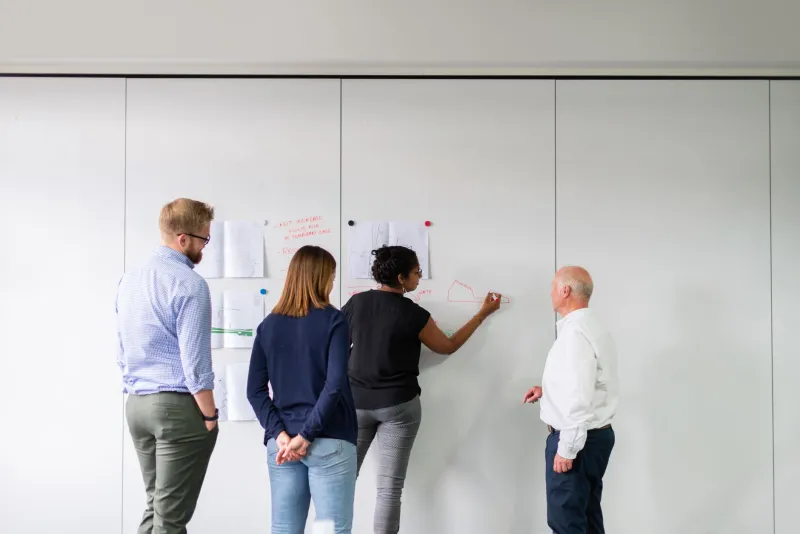
There's a particular kind of meeting that happens in nearly every engineering org at some point. The team has been going back and forth on a big architectural call — maybe it's how to handle service-to-service auth, or whether to go event-driven, or how to structure the data layer for a new product line. After enough whiteboard sessions and Slack threads, someone summarizes the approach, asks if everyone's on board, and the room goes quiet. A few people nod. Someone says "yeah, that works." The decision gets logged and the team moves on.
Six months later, that decision is a problem. Not a minor annoyance — a load-bearing issue that's slowing down three other teams and eating sprint capacity like it's a free buffet.
What went wrong? On paper, the team agreed. In practice, they didn't — not really.
The Anatomy of Fake Consensus
False agreement in technical discussions isn't usually the result of bad faith. Engineers aren't pretending to agree while secretly plotting to undermine a decision. What's actually happening is more subtle and, frankly, more dangerous.
A few dynamics tend to drive it. First, there's the authority gradient. When a senior engineer or tech lead floats an approach, the cognitive friction required to push back goes way up for everyone else in the room. It's not that junior engineers don't have valid concerns — it's that voicing those concerns feels like a career risk, even in teams that explicitly say dissent is welcome. That gap between stated culture and felt experience is where a lot of good engineering judgment quietly disappears.
Second, there's what you might call decision fatigue consensus. By the time a team gets to the third or fourth meeting on a topic, people are tired. The original problem framing has been debated, the options have been enumerated, and everyone just wants to ship something. At that point, "good enough" agreement is a lot more appealing than another round of back-and-forth. The team converges not because they've genuinely resolved the trade-offs, but because they've run out of energy to keep exploring them.
Third — and this one is easy to miss — there's the illusion of shared mental models. Two engineers can use the exact same words to describe an architecture and mean completely different things. One person hears "eventual consistency" and thinks "a few seconds of lag, totally manageable." Another hears it and thinks "we'll need compensating transactions and a whole reconciliation layer." Both nod. Neither realizes they're picturing different systems.
What Gets Buried Under the Nod
The trade-offs that don't get surfaced in these meetings don't vanish. They just migrate downstream, showing up later as operational surprises, scaling bottlenecks, or integration headaches that nobody budgeted for.
Architectural debt of this kind is particularly nasty because it's invisible until it isn't. A team might run smoothly for months before hitting the edge case that the original decision implicitly assumed away. By then, the context is gone, the people who made the call might have moved to different roles, and reversing course is expensive in ways that are hard to explain to stakeholders who weren't in those early meetings.
The decisions most likely to cause this kind of pain share a few characteristics: they involve distributed state, they sit at team or service boundaries, they assume load patterns that haven't been validated, or they punt on failure handling with a vague "we'll deal with that later" that never materializes into an actual plan.
Building Structures That Surface Dissent
The fix isn't to make every architectural discussion a formal adversarial debate — that's exhausting and counterproductive. What works better is building lightweight forcing functions into your decision process that make it easier for genuine concerns to surface before they get buried.
Assign a designated skeptic. Pick someone — rotate the role if you want — whose explicit job in the meeting is to stress-test the proposed approach. This isn't about being contrarian for its own sake. It's about giving someone social permission to ask the uncomfortable questions without it feeling like a personal attack on whoever proposed the architecture. When pushback is a role rather than a personality trait, it's a lot easier to stomach.
Write down the assumptions, not just the decisions. Architecture decision records (ADRs) get a lot of love in the engineering community, but most implementations focus on capturing what was decided rather than what the team assumed to be true when they made the call. Those assumptions are where the real risk lives. Document them explicitly — expected load, failure modes you're not handling, dependencies you're taking for granted — and you've created a forcing function for the team to actually articulate what they're betting on.
Do a pre-mortem before you finalize anything big. Give the team ten minutes to write down, independently and privately, how this decision could blow up in a year. Collect those answers before anyone reads them aloud. You'll surface concerns that would never come up in a normal discussion because the social dynamics of the meeting suppress them. Pre-mortems work precisely because they give people permission to be pessimistic in a context where optimism is usually the default.
Create asynchronous dissent channels. Not every engineer is comfortable speaking up in real-time. A shared doc where people can add concerns anonymously — or even just a 24-hour comment window after a decision is proposed — gives the quieter voices in the room a path to contribute that doesn't require them to interrupt a senior engineer mid-sentence.
The Precision Problem
At QuiverX, we spend a lot of time thinking about precision — not just in tools and systems, but in the decisions that shape them. A vague architectural agreement is the engineering equivalent of a blurry requirement: it looks like progress right up until the moment it becomes a blocker.
The teams that build the most durable systems aren't necessarily the ones with the smartest engineers or the most rigorous process. They're the ones that have figured out how to make it safe — and structurally easy — for people to say "I'm not sure this is right" before the concrete sets.
False consensus is a precision problem. You think you've aligned on something specific, but you've actually aligned on a fuzzy approximation that different people will implement differently. The nod in the meeting room is not the same thing as a shared understanding of the system you're building.
The next time your team reaches the quiet moment at the end of an architecture discussion, resist the urge to take the silence as a green light. Ask one more question. Flip the frame. Make someone argue the other side for two minutes. The friction is worth it — a lot more worth it than the six-month fire drill you're quietly setting yourself up for.